


Beyond 1.5°C: Not to Despair
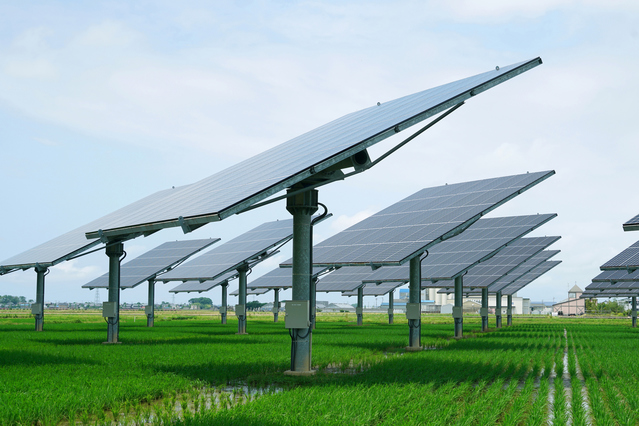
Japan’s agrivoltaics system, also known as agricultural solar power generation or solar sharing, involves installing solar panels above farmland to allow farming and power generation to coexist. This system contributes to the effective use of farmland and secures a stable source of income through electricity sales. It also promotes decarbonization and is being promoted by the Ministry of Agriculture, Forestry and Fisheries under a permit system.
Photo: Kojiro / photolibrary
Editor’s note: This article first appeared in the November 2025 issue of Sekai, as the 38th and penultimate installment of the series Kiko Saisei no Tame ni (For Climate Renewal).
This is actually my final contribution to this series. I am grateful for the opportunity I have had to explore the scientific and social aspects of climate change in my own way.
In this article, I will discuss how we should respond to the imminent reality of a 1.5°C global average temperature rise and the attitude we should adopt moving forward.
Japan’s record-breaking heatwaves and global warming
The summer of 2025 in Japan was astonishingly hot. The daily maximum temperature reached 41.8°C, far higher than ever before, and the number of people receiving medical attention for heatstroke increased sharply across the country.[1] Many people undoubtedly felt the seriousness of climate change firsthand. In lectures and interviews, I have been asked many times if the Earth has passed the “tipping point[2]” from which there is no turning back, entering an acceleration phase.
In fact, if we look at the global average temperature, we see that, after rising significantly from 2023 to 2024, it remained at a more moderate level in 2025 than in the previous year. In other words, the abnormally high temperatures in Japan this summer do not directly indicate an acceleration of global warming.
Japan experienced excessive heat this summer due to a weather pattern in which the Pacific High and the Tibetan High overlapped. This caused westerly winds to shift northward. This was further exacerbated by high sea surface temperatures around Japan. Natural variability, such as the Pacific Decadal Oscillation (PDO)[3], is believed to have contributed to the increase in sea surface temperatures, which may stabilize in the future.
In other words, global warming is not progressing at the same pace as it did in Japan during the summer of 2025, which is somewhat reassuring. However, the current level of global warming is “already so high” that incredibly high temperatures like those experienced in Japan this summer could occur, depending on how natural variability plays out.
The meaning of exceeding “1.5°C”
Meanwhile, long-term global warming is steadily progressing. The rise in the global average temperature due to human activities is currently estimated to be 1.36°C above pre-industrial levels (including the impact of natural variability, it has temporarily exceeded 1.5°C[4]). At the current rate of increase, it is expected to exceed 1.5°C around 2030. Realistically, it is impossible to reduce annual carbon dioxide emissions of approximately 40 billion tons in just a few years, so this outlook is unlikely to change significantly.
It is important to clarify the meaning of the “1.5°C” target. This number represents the international community’s commitment to not abandoning vulnerable people and future generations who will experience significant harm despite not being responsible for the causes. Therefore, accepting a 1.5°C temperature increase is essentially saying, “Sorry, we couldn’t save you.”
Exceeding 1.5°C would increase the likelihood of reaching tipping points, such as the collapse of ice sheets. Those in vulnerable positions will suffer the damage first and most severely. It is a fact that we cannot help but accept with sorrow.
Thinking about this situation reminds me of the current situation in Gaza. Whenever I see images of starving children on the news, I feel a sense of unacceptable cruelty. At the same time, however, I have also come to accept this reality. Overwhelmed by feelings of powerlessness and guilt, some people can only hope for an immediate improvement in the situation by taking small actions, such as signing petitions.
I believe that accepting a 1.5°C increase is comparable. Rising sea levels, storm surges, and droughts are causing people around the world to lose access to water and food, forcing them to flee their homes. We must remember these people, accept the reality, and keep in mind that we must never accept it. We have no choice but to accelerate our efforts to decarbonize in order to improve the situation as quickly as possible.
Climate policy in the age of populism
So, what are the prospects of the world actually moving toward decarbonization? Here, I would like to focus on major trends in international politics. According to Keio University Professor Hosoya Yuichi, the world is at a “turning point.”[5] The 30-plus years since the end of the Cold War have been an optimistic era marked by the expansion of democracy and globalization. However, a major backlash is currently occurring, and he points out that the next few decades will see a global trend toward systems that prioritize the selfish interests of nations (nationalism) and emotional political approaches (populism) that criticize existing political elites and the international order.
If this assessment is correct, taking measures to combat climate change will become even more difficult. The Paris Agreement established a vision for addressing climate change, a shared threat, through international cooperation. However, nationalists and right-wing populists often reject international cooperation and distort scientific knowledge. The United States under the Trump administration is a prime example of this. If similar forces continue to rise in other countries, the framework for international cooperation will weaken, making the hopes of humanity even more remote.
Amid this, one hope that remains is the trend of “post-populism,” which promotes realistic policies while incorporating populist elements. Italy’s Giorgia Meloni administration is a prime example. It is tough on immigration but has also shown a pragmatic side in addressing climate change by promoting agricultural solar power generation, or agrivoltaics.[6] This demonstrates that an administration prioritizing national interests may still recognize the necessity of decarbonization.
The future of the United States is also important. The outcome of the next presidential election will greatly impact the future of international cooperation. Hope lies with the younger generation. Support for climate change measures is growing among young Republicans. Through voting and grassroots activism, they may be able to help the United States rejoin the Paris Agreement. Our hope lies in whether the future leaders can carve out a new direction.
A turning point for the energy system
Another source of hope lies in technology and the economy. In 2024, renewable energy sources accounted for over 90% of the new power generation capacity installed worldwide, indicating that the global energy system has already passed a historic turning point.
Over the past decade, the costs of solar, wind, and battery power have fallen dramatically. Now, renewable energy is a realistic option for developing countries because it can supply electricity more cheaply and quickly than conventional thermal power plants.
Although the Trump administration largely halted the Biden administration’s renewable energy support policies in the United States, the market trend cannot be completely stopped. Renewable energy is already competitive and continues to be adopted by corporations and local governments.
China is leading this trend. The country has rapidly promoted renewable energy and electric vehicles, and despite continued increases in energy demand, carbon dioxide emissions have begun to decline since 2024. China also supplies affordable solar panels and batteries worldwide, encouraging their widespread adoption in Africa and other regions.
Of course, increasing dependence on China raises concerns about economic security. Securing resources and diversifying supply chains are challenging tasks. However, the forces of change brought about by markets and technology are moving forward and transcending political conflict.
Coexistence of national interests and human rights
So, what should we consider in this situation? One thing is certain: we can no longer think about climate change within the traditional framework of liberal governments in developed Western countries persuading the world to move forward. In the future, conservative governments and emerging countries will likely play increasingly leading roles. In this regard, a narrative that frames climate policy as a pursuit of national interests will be crucial.
For Japan, expanding renewable energy will improve the trade balance by reducing fossil fuel imports, thereby increasing energy independence. Agrivoltaics stabilize farmers’ incomes, improve working conditions in extreme heat, and contribute to food security. From a national interest perspective, decarbonization is a rational path.
At the same time, concerns have been raised that climate policy will be driven solely by national interests. It will be an important role for liberal forces to pay attention to those whose rights are violated in various ways in the process and to call for systemic improvements. One strategy for maintaining a vision of decarbonization that transcends differences in position, both in Japan and around the world, is to allow the national interest narrative and the human rights narrative to coexist in a complementary manner, rather than in conflict.
When “we” are no longer powerless
Finally, I’ll state my position. Frankly, the prospect of the world truly moving toward decarbonization feels like leaving it up to fate. As for my ability to influence it, I’m practically powerless on my own.
Nevertheless, I choose to stand with those who want to advance decarbonization. I believe this choice gives my life positive meaning. I also believe that as more people join us, we will no longer be powerless.
A time when temperatures exceed 1.5°C above pre-industrial levels is inevitable. I hope to face that time without despair and, beyond that, to walk alongside those determined to move forward.
Translated from “‘1.5 ℃’ wo Koetemo Zetsuboshinai Tame ni (Beyond 1.5°C: Not to Despair),” Sekai, November 2025, pp. 194-197. (Courtesy of Iwanami Shoten, Publishers) [February 2026]

EMORI Seita, Vice Director, Institute for Future Initiatives
Professor, Institute for Future Initiatives, The University of Tokyo
Graduated from the College of Arts and Sciences, the University of Tokyo. Earned his Ph.D. at the Graduate School of Arts and Sciences, the University of Tokyo.
Since 1997, he had been working at the National Institute for Environmental Studies (NIES), serving as Head of the Climate Risk Assessment Section and Deputy Director of the Earth System Division, among other positions. In 2022, appointed Professor at the Institute for Future Initiatives, the University of Tokyo, and concurrently serves as Professor at the Graduate School of Arts and Sciences.
Lead author of the Fifth and Sixth Assessment Reports of the Intergovernmental Panel on Climate Change (IPCC).
[1] From May to September 2025, a total of 100,510 people were transported by ambulance due to heatstroke nationwide, according to the Fire and Disaster Management Agency of the Ministry of Internal Affairs and Communications. This is the highest number of transports since records began in 2008. 2025 experienced an extended period of intense heat, with June recording the highest number of transports and September the second-highest.
https://www.fdma.go.jp/disaster/heatstroke/items/r7/heatstroke_nenpou_r7.pdf (in Japanese)
[2] The “tipping point” refers to the point at which global warming reaches a threshold in the environment, triggering a chain reaction of unstoppable changes. Examples include the melting of the Greenland and Antarctic ice sheets, the disappearance of the Amazon rainforest, and the mass death of coral reefs. This is feared to impact other systems, causing the entire planet to transition to a different, warmer stable state.
[3] The Pacific Decadal Oscillation (PDO) is a long-term climate change phenomenon in which sea surface temperatures and atmospheric pressure in the North Pacific alternate between high and low levels in cycles of 10 to several decades. It is similar to the El Niño phenomenon but lasts longer, affecting global weather and the stagnation or acceleration of global warming.
[4] https://climatechangetracker.org/climate-change-progress
[5] https://www.youtube.com/watch?v=uJBs5qrH5JY (in Japanese)
[6] Agrivoltaics is a system in which solar panels are placed on poles erected on farmland, allowing farming and electricity generation to occur simultaneously in the same place.
Keywords
- climate change
- 1.5°C
- tipping point
- climate policy
- Paris Agreement
- renewable energy
- agrivoltaics
Related posts:
 Sakaguchi and Kitagawa win Nobel Prize: Japan celebrates dual achievement in same year as two researchers who persevered through adversity call for support for basic research
 Sanaenomics: Tackling a Historic Turning Point
 Japan’s International Cooperation Seen from Palau: Rising Geopolitical Interests, Principles and Strategies under Scrutiny
 China’s Expanding Presence in Central Asia: Its Global Strategy and Public Responses
 Afghanistan Earthquake: Relief Activities by Peace Japan Medical Services and Peshawar-kai